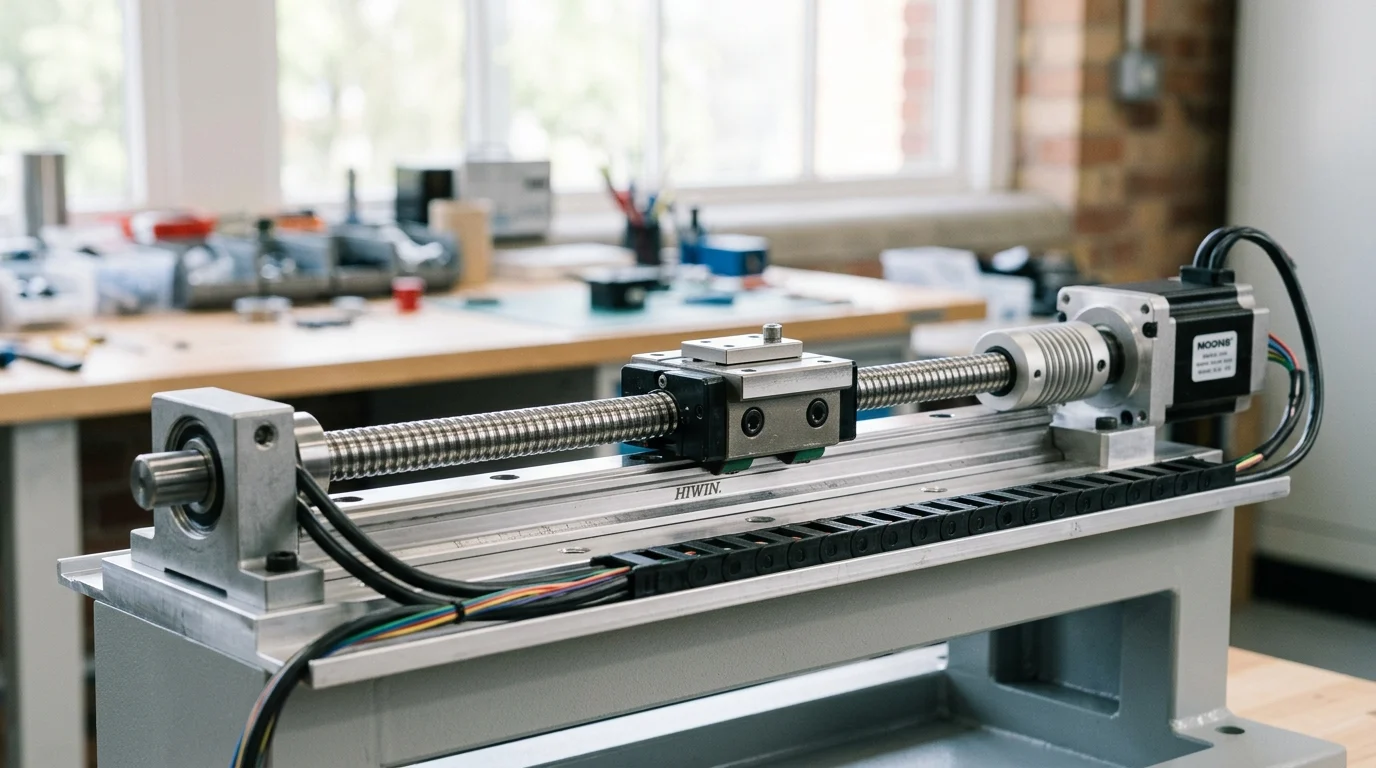
In linear motion design, the most advanced option is not always the most practical one. Trapezoidal lead screws continue to earn their place in industrial equipment because they combine simple mechanics, strong axial load capacity, and predictable holding behavior. Built around the DIN 103 metric profile and a 30-degree flank angle, they trade the high efficiency of ball screws for durability, lower cost, and resistance to back-driving. This article explains how trapezoidal screws convert rotary motion into linear travel, why their sliding-contact design still matters, and where manufacturers such as CSHungan apply them in customized transmission components for demanding machinery.
Why Trapezoidal Screws Still Matter
Trapezoidal screws remain a foundational technology in modern linear motion systems, providing a robust and mechanically simple method for translating rotational forces into linear movement. Governed primarily by the DIN 103 standard for metric dimensions, these components utilize a distinctive 30-degree flank angle that balances load-bearing capacity with manufacturability. Despite the rapid advancement of alternative linear drive technologies, trapezoidal thread mechanisms continue to anchor countless industrial applications due to their unique tribological properties and mechanical reliability.
The enduring relevance of this technology is rooted in its inherent mechanical simplicity. Lacking complex rolling elements, trapezoidal drives operate on the principle of sliding friction. This fundamental characteristic, while presenting certain efficiency limitations, yields a highly resilient system capable of withstanding heavy shock loads, aggressive environments, and static holding requirements that would otherwise compromise more delicate precision assemblies.
How They Convert Rotary Motion into Linear Motion
At the core of a trapezoidal screw drive is the sliding friction mechanism between the metallic screw shaft and the internally threaded nut. As the motor or handwheel rotates the screw, the angled flanks of the thread push against the mating flanks of the nut, forcing it to travel linearly along the shaft axis. Because this is a sliding action rather than a rolling one, a significant portion of the input energy is dissipated as heat.
The efficiency of this rotary-to-linear conversion typically ranges from 20% to 40%, depending heavily on the materials used, the surface finish of the threads, and the lubrication state. While this efficiency is relatively low compared to rolling-element drives, the sliding contact provides a massive surface area for load distribution. This extensive contact area prevents localized stress concentrations, allowing the system to absorb substantial axial shock loads without suffering the brinneling or surface spalling that plagues ball screw mechanisms.
Why They Remain Cost-Effective
Cost-effectiveness is driven primarily by the high-volume manufacturing processes used to produce both the screws and the mating nuts. The majority of industrial trapezoidal screws are produced via cold rolling. This process not only forms the threads rapidly with minimal material waste but also work-hardens the surface, enhancing wear resistance and yielding a smooth surface finish (often between Ra 0.8 and 1.6 µm).
Compared to precision-ground ball screws, cold-rolled trapezoidal screws can yield a 30% to 50% reduction in component costs. Furthermore, the absence of complex ball recirculation circuits in the nut significantly lowers the cost of the mating component. Maintenance costs are similarly reduced; when a trapezoidal nut reaches the end of its wear life, it can be replaced quickly and economically without requiring specialized handling or cleanroom environments.
Where They Fit in Modern Motion Systems
Despite the proliferation of high-speed servomotor drives and ultra-precise linear motors, trapezoidal threads maintain a strong presence in modern automation architectures. They are highly specified for Z-axis configurations and vertical lifting mechanisms where gravitational forces pose a risk of back-driving during a power failure. The inherent friction of the trapezoidal profile acts as a natural brake, securing loads safely in place.
Beyond static holding, they are the preferred choice for format adjustment axes in packaging and assembly machinery. In these scenarios, the axis may only move a few millimeters a day to adjust for different product sizes. Deploying an expensive, high-efficiency ball screw for an axis with a 1% duty cycle represents poor capital allocation. Trapezoidal screws fulfill these intermittent positioning requirements perfectly, offering high holding forces and mechanical stability at a fraction of the cost.
Key Performance Characteristics

Understanding the performance parameters of trapezoidal screws is critical for matching the component to the application's demands. Unlike rolling-element drives, where fatigue life can be calculated with high statistical certainty (such as the L10 life equation), sliding-contact drives are governed by wear rates, heat generation, and material compatibility. Engineers must carefully evaluate thread geometry, dynamic load limits, and material pairings to ensure long-term reliability.
Thread Geometry, Lead Angle, and Self-Locking
Thread geometry dictates the fundamental mechanics of the drive. Governed by standards such as DIN 103, trapezoidal threads utilize a 30-degree flank angle, distinguishing them from the 29-degree Acme thread standard common in North America. The relationship between the pitch (the distance between adjacent threads) and the lead (the linear distance traveled in one full revolution) determines the system's mechanical advantage and speed.
A critical characteristic derived from this geometry is self-locking capability. When the lead angle of the thread is less than roughly 5 degrees, the system generally resists back-driving under static loads. This means that an axial force applied to the nut will not cause the screw to rotate. This self-locking threshold is highly dependent on the coefficient of friction; vibrations or dynamic loads can occasionally overcome the static friction, causing a theoretically self-locking screw to creep. Therefore, engineers often target a lead angle below 3 degrees for critical fail-safe holding applications.
Load Capacity, Speed Limits, and Duty Cycle
Load capacity in a trapezoidal drive is a function of the nut material's compressive strength and the total thread contact area. However, the true limiting factor is rarely static overload; it is the combination of pressure and velocity, known as the PV value. As sliding speed increases, frictional heat generation rises exponentially. If the heat cannot dissipate faster than it is generated, the nut material will rapidly degrade, melt, or seize.
Because of this thermal limitation, max surface speeds are typically restricted to less than 0.5 meters per second. Furthermore, duty cycles for trapezoidal screws are usually limited to 20% to 30%. This means the drive must rest for at least 70% of its operational time to allow heat to dissipate. Continuous 100% duty cycle operation is generally strictly prohibited unless the loads are exceptionally light or specialized cooling and lubrication systems are integrated.
Materials, Coatings, and Nut Options
Material selection dictates wear resistance, friction coefficients, and environmental suitability. Screws are predominantly rolled from medium carbon steel, such as C45, which offers a good balance of tensile strength and cost. For corrosive environments, 304 or 316 stainless steel variants are utilized, though they exhibit slightly lower yield strengths.
Nut options range from traditional bronze alloys to advanced engineered polymers. Bronze nuts offer excellent high-load capacities and thermal conductivity but require regular lubrication. Polymer nuts, such as those made from POM (Delrin) or advanced PTFE blends, provide self-lubricating properties and silent operation, though at the expense of lower maximum load ratings.
| Material Pair | Max Dynamic Load | Typical Friction Coefficient (Dry / Lubricated) | Max Operating Temp |
|---|---|---|---|
| Steel / Bronze | High (up to 15 N/mm²) | 0.15 / 0.10 | 150°C |
| Steel / POM | Low (up to 2.5 N/mm²) | 0.18 / 0.05 | 80°C |
| Stainless / PTFE Blend | Medium (up to 5 N/mm²) | 0.10 / 0.04 | 200°C |
Trapezoidal Screws vs Other Linear Drives
Selecting the optimal linear drive requires weighing the inherent trade-offs of sliding friction against the benefits of rolling friction or alternative power transmission methods. While trapezoidal screws are versatile, they operate in a crowded technological landscape alongside Acme screws, ball screws, belt drives, and rack-and-pinion systems. A rigorous comparative analysis is essential to avoid over-engineering a solution or, conversely, specifying a component that will fail prematurely under dynamic stress.
Comparison with Ball Screws and Acme Screws
The primary distinction between trapezoidal and Acme screws lies in regional standardization and thread angle: trapezoidal threads use a 30-degree metric profile (DIN 103), whereas Acme threads utilize a 29-degree imperial profile. Functionally, they behave identically, relying on sliding friction.
When compared to ball screws, the differences are stark. Ball screws utilize recirculating steel spheres to achieve mechanical efficiencies exceeding 90%. This allows for continuous operation, high speeds, and zero backlash through preloading. However, ball screws cannot self-lock and require external braking systems to hold vertical loads. They are also highly sensitive to contamination, as dirt ingress can quickly destroy the rolling elements.
| Feature | Trapezoidal Screw | Ball Screw | Belt Drive |
|---|---|---|---|
| Mechanical Efficiency | 20% - 40% | > 90% | > 95% |
| Self-Locking Capability | Yes (if lead angle < 5°) | No | No |
| Max Linear Speed | ~0.5 m/s | ~1.5 m/s | > 3.0 m/s |
| Backlash | Moderate to High | Low to Zero | Low |
| Dirt Tolerance | Excellent | Poor | Moderate |
When Trapezoidal Screws Are the Better Choice
Trapezoidal screws excel in applications where simplicity, high static load capacity, and fail-safe positioning are paramount. They are the definitive choice for environments subject to heavy vibration or shock loads, such as agricultural machinery or heavy presses. The broad surface contact of the threads absorbs impact forces that would cause immediate brinelling (indentation) in the raceways of a ball screw.
Furthermore, in vertical Z-axes where back-driving must be prevented without relying on an electromagnetic brake, a self-locking trapezoidal screw provides an elegant, inherently safe mechanical solution. Their tolerance for particulate contamination also makes them the superior choice in woodworking, paper processing, and bulk material handling, where maintaining a pristine operating environment is impossible.
When Belts, Racks, or Ball Screws Make More Sense
Conversely, applications demanding high continuous throughput necessitate alternative technologies. If an application requires a duty cycle exceeding 30% or operational speeds greater than 0.5 m/s, the frictional heat generated by a trapezoidal screw will cause catastrophic nut failure. In these scenarios, ball screws are the mandatory choice for precision positioning.
For stroke lengths exceeding 3 meters or speeds surpassing 1 m/s, engineers typically transition away from screws entirely. Belt drives and rack-and-pinion systems do not suffer from the "critical speed" limitations (screw whipping) that restrict long linear screws. Belt drives offer exceptional high-speed performance for lighter loads, while rack-and-pinion systems provide infinite travel lengths and high thrust capabilities for heavy gantry systems.
Specification, Sourcing, and Integration
Proper specification and sourcing are the bridges between conceptual design and reliable field operation. Specifying a trapezoidal screw goes beyond simply selecting a diameter and pitch; it requires a holistic evaluation of the system's kinematic limits, manufacturing tolerances, and the integration of mating components. Engaging with suppliers early in the design phase and enforcing rigorous quality checks ensures the final assembly meets expected lifecycle targets.
Defining Load, Stroke, Speed, and Accuracy Needs
Engineers must define the operational envelope by quantifying load, stroke, and speed requirements. The critical speed (the rotational velocity at which the screw begins to resonate and whip) heavily limits the maximum stroke length. A standard 20 mm diameter screw, for example, may have a theoretical critical speed of 1,500 RPM at a 500 mm length, but that limit plummets to under 400 RPM if the stroke is extended to 1,500 mm without intermediate supports.
Accuracy needs also dictate the manufacturing method. Standard rolled trapezoidal screws typically offer lead accuracies of +/- 0.1 mm to +/- 0.3 mm per 300 mm of travel. If tighter precision is required, engineers must specify milled or ground screws, which significantly increases costs but can achieve lead accuracies tighter than +/- 0.05 mm per 300 mm.
Tolerances, Nut Design, and End Machining
Manufacturing tolerances strictly govern the fit and operational smoothness of the screw assembly. The ISO tolerance class (e.g., 7e for standard rolled screws) dictates the clearance between the screw and the nut. Too tight, and the system risks thermal binding; too loose, and excessive backlash compromises positioning accuracy.
Nut design must also account for unavoidable wear. While standard cylindrical or flanged nuts are common, applications requiring higher precision over time benefit from anti-backlash nut designs. These utilize a preloaded spring mechanism between two separate nut halves to automatically compensate for thread wear, maintaining minimal axial play even after thousands of operational cycles.
Standards, Suppliers, and Quality Checks
Adherence to international standards, predominantly ISO 2901/2903 and DIN 103, ensures interoperability and consistent quality across different suppliers. When auditing suppliers, engineers should request documentation on the surface finish of the rolled threads, targeting a roughness average (Ra) of 0.8 to 1.6 µm to ensure optimal nut life.
When sourcing custom-machined screws with specific end-journal configurations for bearing blocks and motor couplings, engineers should anticipate minimum order quantities (MOQs). While standard threaded rods can be purchased in single units, custom end machining often requires an MOQ ranging from 50 to 100 units for economical production, making prototyping a distinct phase from volume sourcing.
Choosing Trapezoidal Screws for Your Application
Finalizing the selection of a trapezoidal screw involves aligning the technical specifications with the operational realities of the target machine. A successful implementation requires moving beyond theoretical load calculations to address environmental factors, lubrication strategies, and structural alignment. By methodically evaluating decision criteria and establishing a rigorous assembly plan, engineers can maximize the lifespan and reliability of the sliding-friction drive.
Best-Fit Application Scenarios
Trapezoidal screws are the definitive choice for format adjustment mechanisms in packaging machinery, where guide rails must be widened or narrowed to accommodate different box sizes. These adjustments happen infrequently, making the self-locking nature and low cost of the screw ideal. Similarly, they dominate the Z-axis of desktop 3D printers and light CNC routers, where holding position against gravity is more critical than high-speed traversal.
Additionally, they are heavily favored in medical beds, ergonomic workstations, and scissor lifts. In these heavy-duty lifting scenarios, static loads can reach anywhere from 10 kN to 50 kN. The massive thread contact area of a bronze nut on a steel trapezoidal screw safely supports these loads, ensuring patient or operator safety without the risk of sudden back-driving.
Decision Criteria for Final Selection
The final decision rests on evaluating the Pressure-Velocity (PV) factor, a critical metric for sliding friction systems. Engineers must calculate the specific surface pressure on the thread flanks and multiply it by the sliding velocity. If the calculated PV value exceeds the nut material's published limit (e.g., 300 N/mm² * m/min for certain bronze alloys), the design must be altered by increasing the screw diameter, decreasing the speed, or changing the nut material.
Environmental factors also weigh heavily on the final selection. If the application involves exposure to abrasive dust (e.g., stone cutting) or corrosive washdowns (e.g., food processing), a standard C45 steel screw will fail rapidly. Such conditions mandate the selection of a 316 stainless steel variant paired with a specialized, self-lubricating polymer nut to prevent galling and resist chemical degradation.
Turning Selection into an Implementation Plan
Transforming a component selection into a successful implementation requires a rigorous integration and maintenance plan. Because they rely on sliding friction, steel-on-bronze assemblies require strict lubrication schedules. Implementation plans must specify whether the system will utilize manual greasing (typically every 500 to 1,000 operational hours) or an automated centralized lubrication system.
Mechanical alignment during assembly is equally critical. The trapezoidal screw must be installed parallel to the linear guide rails within tight tolerances—often requiring parallelism within 0.05 mm per meter of travel. Any angular misalignment or radial offset will induce severe radial loads on the nut, causing rapid, uneven thread wear and dramatically reducing the system's operational lifespan.
Key Takeaways
- Use trapezoidal screws when a linear motion system needs rugged load support, simple construction, and reliable operation under shock or static loads.
- Expect typical trapezoidal screw efficiency of about 20% to 40%, so account for heat, lubrication, and motor sizing during design.
- Choose cold-rolled trapezoidal screws for cost-sensitive applications, as they can reduce component costs by roughly 30% to 50% compared with precision-ground ball screws.
- Specify trapezoidal screws for vertical lifting or Z-axis mechanisms when resistance to back-driving during power loss is a key safety requirement.
- Plan routine lubrication and economical nut replacement to extend service life without the maintenance complexity of ball recirculation systems.
Frequently Asked Questions
What is a trapezoidal screw used for in linear motion systems?
It converts rotary motion from a motor or handwheel into linear movement, commonly in lifting, positioning, clamping, and adjustment mechanisms.
Why are trapezoidal screws cost-effective?
They are often cold-rolled in high volume, use simpler nut designs, and can cost 30% to 50% less than precision-ground ball screws.
Are trapezoidal screws efficient?
Their typical efficiency is about 20% to 40%, lower than ball screws, because they rely on sliding friction rather than rolling contact.
When are trapezoidal screws better than ball screws?
They are often better for heavy shock loads, vertical lifting, static holding, dirty environments, and applications where cost matters more than high speed.
Do trapezoidal screws prevent back-driving?
Many trapezoidal screw designs offer strong resistance to back-driving, making them suitable for Z-axis and vertical lifting systems where load holding is important.