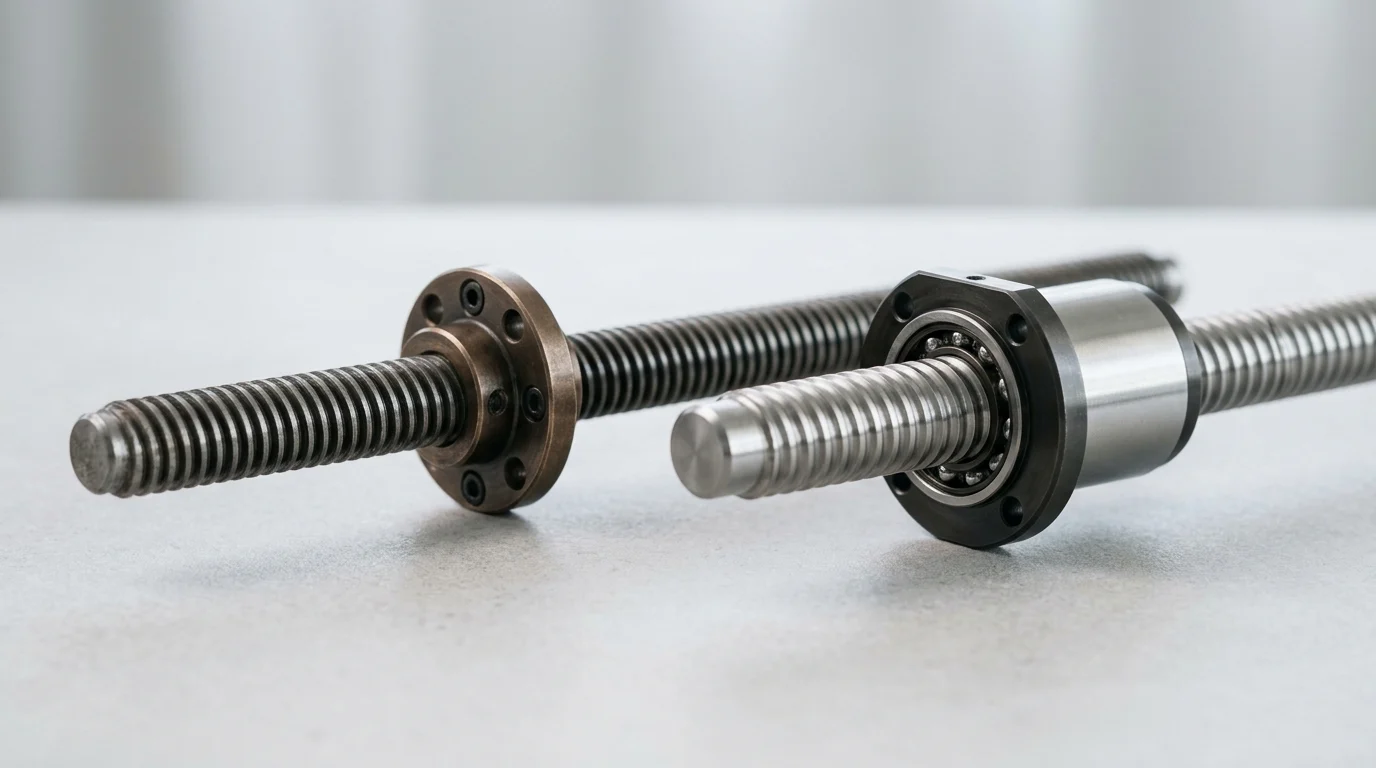
Choosing the right linear drive can determine whether an automation axis runs smoothly for years or struggles with heat, wear, oversizing, and positioning error. In the debate between lead screws and ball screws, the key issue is not which technology is universally better, but which one matches the machine’s load, speed, duty cycle, accuracy, and cost targets. Lead screws remain valuable for compact, economical, and potentially self-locking motion, while ball screws dominate high-efficiency, high-speed, and high-precision applications. This article breaks down the engineering trade-offs behind both options so equipment designers can make a more reliable and cost-aware selection.
Lead Screw vs Ball Screw: Decision Context
Linear motion systems are the foundational arteries of modern automation equipment, responsible for translating motor power into precise, controlled physical positioning. At the core of these systems lies the drive mechanism, which dictates the fundamental capabilities of the machine. The engineering debate between utilizing a lead screw vs ball screw is not merely a matter of preference; it is a critical technical decision that defines an automation system's performance envelope, thermal management requirements, and overall lifecycle cost (often evaluated over a standard 10,000-hour industrial lifespan).
While both mechanisms serve the identical basic function of converting rotary motion into linear travel, they operate on entirely different tribological principles. One relies on sliding friction, while the other utilizes rolling friction. This fundamental divergence in physics cascades through every aspect of machine design, influencing motor sizing, structural rigidity, and maintenance schedules. Selecting the optimal screw technology requires a rigorous analysis of the specific automation environment, moving beyond generalized assumptions to evaluate concrete mechanical metrics.
Why the Choice Matters
The decision between a lead screw and a ball screw directly impacts the electromechanical architecture of the entire automation system. Because the efficiency delta between the two technologies is massive—often ranging from 20% to 40% efficiency for lead screws compared to 90% or higher for ball screws—the choice dictates the required torque output of the driving motor. A system utilizing a sliding-friction drive will require a significantly larger stepper or servo motor (e.g., requiring a 2.0 Nm NEMA 23 motor instead of a 0.5 Nm NEMA 17) to achieve the same linear force as a rolling-friction drive.
Furthermore, this efficiency gap translates directly into thermal dissipation challenges. In high-duty-cycle applications, the energy lost to friction in a lead screw manifests as heat, which can rapidly degrade polymer nuts or cause thermal expansion in the steel shaft, thereby compromising positional accuracy. Engineers must account for these thermal expansion coefficients, which typically hover around 11 to 12 micrometers per meter per degree Celsius for steel components. Misjudging the thermal load can result in premature system failure or unacceptable deviations in precision automation tasks.
Beyond energy dynamics, the choice dictates the rigidity and resonance of the linear axis. Ball screws, particularly when preloaded, offer exceptional axial stiffness, making them indispensable for heavy machining or rapid point-to-point positioning where settling time must be minimized. Conversely, the inherent damping characteristics of polymer nuts used in lead screw assemblies can be advantageous in mitigating vibration, making the choice heavily dependent on whether the application prioritizes extreme stiffness or vibration attenuation.
Where Lead Screws Still Add Value
Despite their lower mechanical efficiency, lead screws maintain a dominant presence in specific automation sectors where their unique physical properties provide distinct advantages over ball screws. One of the most critical advantages is their potential for self-locking. When a lead screw is designed with a sufficiently shallow lead angle—typically less than 5 degrees—the static friction in the nut prevents back-driving under an axial load. This allows a Z-axis mechanism to hold a vertical load of 50 kg or more indefinitely without requiring a continuous power draw or an external electromagnetic brake.
Lead screws also excel in applications requiring extreme miniaturization and low acoustic noise. Because they lack recirculating steel balls, lead screws operate with a smooth, sliding action that eliminates the characteristic clicking or rattling noise associated with ball returns. This makes them the preferred choice for medical infusion pumps, laboratory liquid handling systems, and optical focusing mechanisms where acoustic emissions must be kept below 40 decibels.
Additionally, the economic value of lead screws cannot be overstated. In applications where the extreme speeds and high load capacities of a ball screw are superfluous, specifying a lead screw can reduce the drive mechanism cost by 70% to 90% (often dropping unit costs below $15 for high-volume orders with MOQs over 500). When combined with the elimination of lubrication systems—thanks to self-lubricating polymer nuts—lead screws offer an incredibly lean, maintenance-free solution for light-duty automation, packaging adjustments, and format-changeover mechanisms.
Definitions and Operating Principles
To properly evaluate the capabilities of linear drive systems, it is essential to dismantle the mechanics behind their operation. Both technologies consist of a threaded cylindrical shaft and a mating nut, but the geometric interface between these two components defines their operational parameters. Understanding these definitions and operating principles is the first step in matching the technology to the application's physics.
How Lead Screws Convert Rotary Motion
Lead screws convert rotary motion to linear motion through direct sliding friction. The internal threads of the nut physically engage with the external threads of the shaft. As the shaft rotates, the helical angle of the thread acts essentially as a continuous inclined plane, pushing the nut forward or backward (with leads typically ranging from 1 mm to 25 mm per revolution). This sliding interface means that a significant surface area is in constant contact.
The thread profiles used in lead screws are specifically engineered to manage this sliding contact. The most common profile is the Acme thread, which features a 29-degree thread angle (or the closely related Trapezoidal thread with a 30-degree angle). This trapezoidal geometry provides high strength and ease of manufacturing. Square threads, offering a 0-degree angle, provide the highest efficiency for a sliding screw but are notoriously difficult to machine and compensate for wear.
Because of the direct contact, the coefficient of friction is relatively high. When using a traditional bronze nut on a steel shaft without lubrication, the friction coefficient can range from 0.10 to 0.20. To combat this, modern automation equipment frequently utilizes advanced thermoplastic nuts blended with PTFE (Teflon), silicone, or graphite. These engineered polymers lower the dynamic coefficient of friction to between 0.05 and 0.09, enabling dry-running, maintenance-free operation in cleanroom environments.
How Ball Screws Use Recirculating Balls
Ball screws replace the sliding friction of a lead screw with rolling friction, fundamentally altering the performance profile. The threads on both the shaft and the nut are precision-machined to form a helical raceway. Precision steel or ceramic ball bearings fill this raceway, acting as the load-bearing interface between the nut and the shaft. As the screw rotates, the balls roll through the grooves, propelling the nut linearly.
A critical component of this design is the recirculation mechanism. Because the balls travel axially as they roll around the shaft, they must be continuously routed back to the beginning of the nut's thread to maintain an endless loop. This is achieved using return tubes, internal deflectors, or end-cap recirculators. The rolling action drastically reduces the coefficient of friction to an incredibly low 0.003 to 0.01.
To maximize load capacity and rigidity, ball screw raceways typically utilize a Gothic arch profile. This specialized geometry provides a four-point contact interface for each ball bearing, contrasting with the two-point contact of a simple circular arc. The Gothic arch allows the ball nut to be preloaded—where slightly oversized balls are inserted to eliminate all internal clearance—resulting in zero backlash and immense structural rigidity capable of handling dynamic loads exceeding 100 kN (approximately 22,480 lbf) in heavy automation machinery.
Key Terms: Lead, Pitch, Backlash, and Efficiency
Navigating linear motion specifications requires a firm grasp of industry terminology. 'Lead' and 'Pitch' are frequently confused but represent distinct measurements. Pitch is the linear distance between two adjacent threads on the screw shaft. Lead is the actual linear distance the nut travels during one complete 360-degree revolution of the shaft. On a single-start screw, lead and pitch are identical. However, on a multi-start screw (which features multiple independent thread helices intertwined), the lead equals the pitch multiplied by the number of starts.
Backlash is the axial clearance or 'play' between the nut and the screw threads. When the motor reverses direction, backlash represents the dead-band where the screw turns but the nut does not immediately move. Standard lead screws can exhibit backlash from 0.05 mm to 0.25 mm. To correct this, anti-backlash lead nuts utilize a spring-loaded two-piece design (typically rated for 1 to 5 million inches of travel) to continuously take up wear, reducing backlash to less than 0.02 mm. Ball screws eliminate backlash entirely through mechanical preloading.
Efficiency refers to the percentage of rotary mechanical energy successfully converted into linear mechanical energy. The equation for efficiency incorporates the lead angle and the coefficient of friction. Ball screws routinely achieve efficiencies of 90% to 95%, meaning nearly all motor torque translates into linear force. Lead screws, constrained by sliding friction, typically operate at 20% to 50% efficiency, meaning up to 80% of the input energy is lost as heat.
Key Technical Comparison Factors
When engineering an automated system, qualitative descriptions must give way to hard quantitative data. The mechanical differences between sliding and rolling friction create distinct performance boundaries. By comparing these technologies across critical technical factors, designers can establish which system meets the minimum viable specifications for a given axis of motion.
Efficiency, Speed, Load, and Accuracy
The most stark contrast between the two technologies lies in their speed and load capacities. Ball screws are designed for high-throughput automation. A standard precision ball screw can comfortably operate at 3,000 to 4,000 RPM, translating to linear velocities exceeding 1.5 meters per second, depending on the lead. They are engineered to bear immense forces, with heavy-duty variants supporting dynamic loads well over 100,000 Newtons (100 kN).
Conversely, lead screws are speed-limited by heat generation. Pushing a polymer lead nut beyond 400 to 500 RPM rapidly elevates the interface temperature, risking localized melting or rapid abrasive wear. Consequently, lead screws are typically restricted to linear velocities below 0.3 meters per second. Their load capacity is also more modest, generally maxing out around 5 kN to 10 kN for standard automation diameters, though large-diameter bronze nuts can handle higher loads at very low speeds.
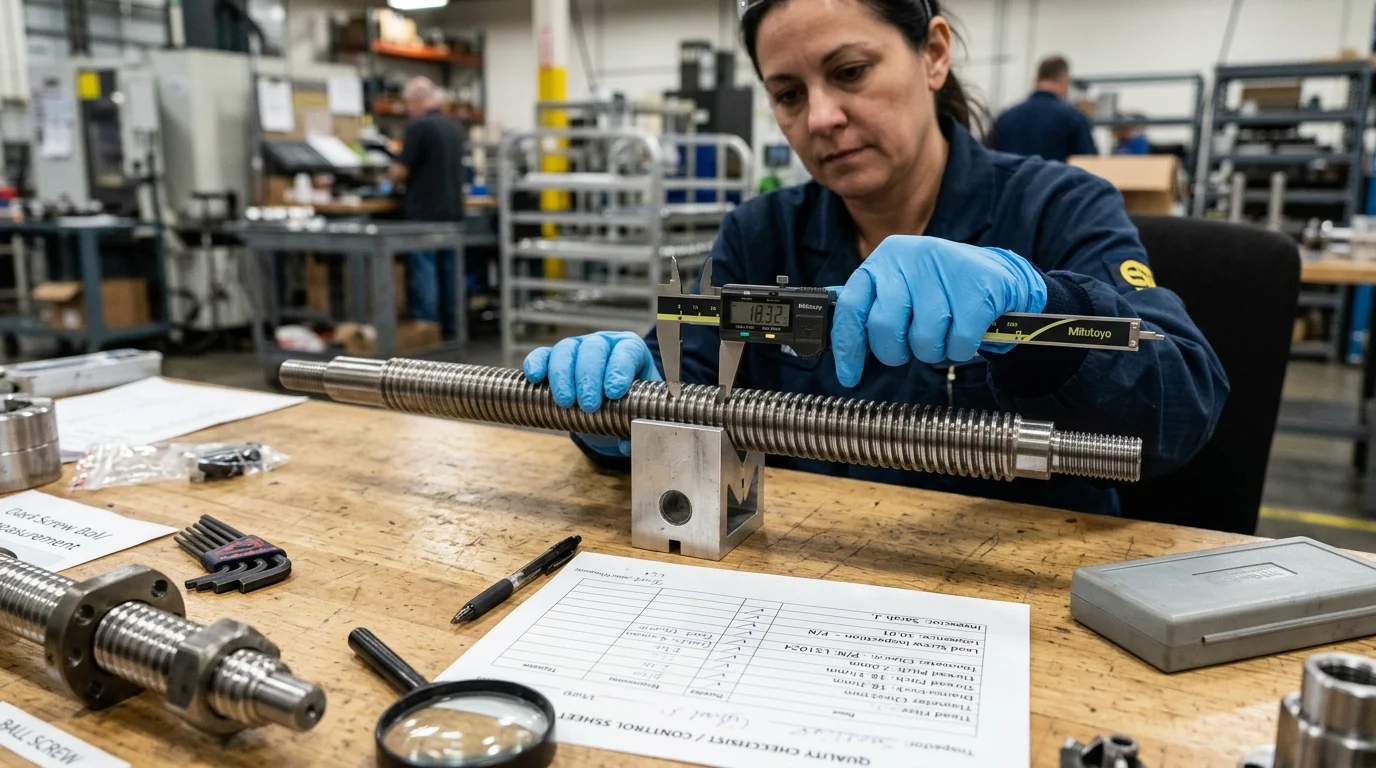
Accuracy and repeatability also diverge significantly. Ball screws are manufactured to strict ISO 3408 tolerance classes. A C3 precision ground ball screw, for instance, guarantees a maximum lead error of just 0.012 mm over 300 mm of travel. While precision-rolled lead screws can achieve respectable accuracies (often around 0.075 mm per 300 mm), they cannot match the sub-micron repeatability of a preloaded, ground ball screw used in CNC machinery or semiconductor lithography.
| Technical Specification | Lead Screw (Polymer Nut) | Ball Screw (Standard) |
|---|---|---|
| Mechanical Efficiency | 20% - 50% | 90% - 95% |
| Max Operating Speed | ~500 RPM | 3,000+ RPM |
| Dynamic Load Capacity | Low to Moderate (< 10 kN) | Very High (up to 100+ kN) |
| Positioning Accuracy | 0.050 - 0.100 mm / 300mm | 0.005 - 0.023 mm / 300mm |
| Backlash (Standard) | 0.05 - 0.25 mm (Requires anti-backlash nut) | Zero (with preload) |
Duty Cycle, Self-Locking, and Contamination Risk
Duty cycle—the ratio of operational time to resting time—is a critical constraint for lead screws. Because sliding friction generates substantial heat, polymer nuts typically require a duty cycle limit of 30% to 50% to allow for thermal dissipation. Exceeding this limit causes thermal expansion, increasing friction further in a destructive feedback loop. Ball screws, generating negligible heat due to rolling friction, can easily sustain a 100% continuous duty cycle in 24/7 automation lines.
However, the high efficiency of ball screws introduces a specific hazard: back-driving. A ball screw cannot hold a vertical load without power; the weight of the load will force the nut down, back-driving the motor. This necessitates the integration of fail-safe electromagnetic brakes, adding cost and complexity. Lead screws with an efficiency below 50% (typically those with a lead angle under 5 degrees) are inherently self-locking, offering intrinsic safety for vertical Z-axes during power loss.
Environmental contamination poses different risks to each technology. Ball screws are highly sensitive to particulate matter. Dust, metal chips, or grit entering the ball nut can cause brinelling—microscopic indentations in the steel raceway—which rapidly destroys the assembly. They require complex bellows or wiper seals (often required to achieve IP65 or IP67 system ratings). Lead screws, particularly those with softer polymer nuts, are more forgiving. The wiping action of the tight-fitting nut can clear debris from the shaft, and minor particulate embedding in the plastic does not catastrophically fail the steel shaft.
Maintenance, Noise, and Service Life
Maintenance requirements heavily favor modern lead screw technology. When equipped with internally lubricated engineered polymer nuts (such as Acetal blended with PTFE), lead screws are completely self-lubricating. They operate completely dry, meaning they do not attract abrasive dust and require zero maintenance interventions throughout their operational lifespan. This makes them ideal for inaccessible mechanisms or cleanroom environments where liquid lubricants are prohibited.
Ball screws demand strict, ongoing lubrication schedules. The rolling steel balls require a continuous film of oil or lithium-based grease to prevent metal-on-metal wear and catastrophic spalling. In heavy automation, this often requires automated, centralized lubrication systems that dispense precise amounts of NLGI Grade 2 grease every 500 to 1,000 kilometers of linear travel. Failure to maintain the lubrication film will reduce the ball screw's service life by up to 90%.
Acoustic emissions also differ due to the underlying physics. The recirculation of steel balls in a ball screw generates a distinct, continuous rattling or humming noise, which typically registers between 60 and 75 decibels at high speeds. In environments where noise pollution is a concern—such as patient-facing medical devices or laboratory environments—the near-silent sliding action of a polymer lead nut, often operating below 40 decibels, provides a distinct ergonomic advantage.
Application and Sizing Criteria
Translating technical specifications into practical application requires a systematic approach to sizing and selection. Automation engineers must evaluate the specific motion profile—including mass, velocity, acceleration, and orientation—to determine which screw technology will survive the application's demands. Sizing linear drives is an exercise in managing physical limits, particularly regarding shaft deflection, thermal boundaries, and column loading.
When to Choose a Lead Screw
Lead screws are the optimal choice when the application demands cost-effective, low-maintenance motion at moderate speeds. They are heavily utilized in the life sciences sector; for example, in automated pipetting systems and syringe pumps, where linear velocities rarely exceed 50 mm/s and smooth, vibration-free fluid delivery is paramount. The absence of rolling elements ensures no micro-pulsations occur during extremely slow travel.
They are also the default choice for format adjustment mechanisms in packaging automation. When a conveyor rail or sensor bracket only needs to be repositioned during a product changeover—operating perhaps twice a day for 10 to 15 seconds—investing in a continuous-duty ball screw is economically inefficient. A self-locking lead screw provides the exact holding force required without the need for auxiliary braking systems.
Furthermore, lead screws thrive in harsh, corrosive, or vacuum environments where standard lubrication fails. By utilizing a 316 stainless steel shaft paired with a PEEK or Vespel polymer nut, engineers can deploy lead screws in semiconductor vacuum chambers or washdown food-processing zones where grease would outgas or wash away, causing immediate failure in a ball screw.
When to Choose a Ball Screw
Ball screws are mandatory for industrial applications characterized by high throughput, heavy loads, and continuous operation. In CNC machining centers, where the axes must interpolate complex geometries while resisting massive cutting forces, preloaded ball screws provide the necessary axial stiffness (often exceeding 500 N/μm) and zero-backlash precision to maintain part tolerances.
They are equally critical in high-speed pick-and-place robotics and automated storage and retrieval systems (ASRS). When a gantry system must move a 100 kg payload at velocities of 1 to 2 meters per second, the low friction of a ball screw minimizes the required motor size and prevents the catastrophic heat buildup that would melt a lead screw nut within minutes.
Additionally, ball screws are chosen for precision positioning stages in semiconductor metrology and laser cutting. Ground ball screws, paired with high-resolution optical linear encoders, allow for closed-loop positioning systems that can achieve nanometer-level step resolutions (e.g., 10 to 50 nm), far exceeding the capabilities of sliding-friction mechanisms.
Practical Sizing Steps for Load and Speed
Regardless of the chosen technology, engineers must perform rigorous sizing calculations. The first critical step is verifying the Critical Speed. As a rotating shaft spins, it reaches a resonant frequency where it begins to whip like a jump rope. Critical speed is a function of the shaft's root diameter, unsupported length, and end-bearing fixity (e.g., fixed-free, supported-supported). To ensure safety, the maximum operating speed must never exceed 80% of the calculated theoretical critical speed.
The second calculation is the Buckling Load (Column Strength). When a screw is subjected to a compressive axial load, the shaft acts as a slender column. If the load exceeds the column strength, the shaft will buckle and permanently deform. This is particularly crucial for long-stroke vertical applications. Like critical speed, buckling calculations heavily depend on end fixity; a shaft firmly clamped in angular contact bearings at both ends can support up to four times the compressive load of a shaft supported only at one end. A safety factor of 2.0 to 3.0 is typically applied to buckling calculations to account for shock loads.
For lead screws specifically, engineers must calculate the PV (Pressure-Velocity) factor. The PV factor is the product of the bearing pressure (psi) and the sliding velocity (feet per minute). Every polymer nut material has a maximum PV limit; for example, standard Acetal nuts typically have a PV limit of 10,000 psi-fpm. Exceeding this limit guarantees rapid thermal failure. By calculating the application's PV and comparing it to the material limits, engineers can definitively size the lead nut for the required lifespan.
Cost, Sourcing, and Final Selection
The final phase of specifying a linear motion system moves beyond physics and into commercial engineering. Automation OEMs must balance performance with supply chain realities, procurement budgets, and long-term operational costs.
Key Takeaways
- Compare lead screws and ball screws by duty cycle, load, speed, precision, thermal behavior, and lifecycle cost rather than by purchase price alone.
- Use ball screws when high efficiency is essential, because they can exceed 90% efficiency compared with roughly 20% to 40% for many lead screw systems.
- Account for frictional heat in lead screw designs, since thermal expansion in steel components can reach about 11 to 12 micrometers per meter per degree Celsius.
- Consider lead screws for applications that benefit from quiet operation, vibration damping, simpler construction, and potential self-locking at shallow lead angles.
- Select a customized trapezoidal lead screw and nut material combination when standard catalog parts cannot meet the automation equipment’s load, space, or wear requirements.
Frequently Asked Questions
What is the main difference between a lead screw and a ball screw?
A lead screw uses sliding friction between the screw and nut, while a ball screw uses circulating balls for rolling friction. This makes ball screws much more efficient, while lead screws can be simpler, quieter, lower cost, and sometimes self-locking.
When should automation equipment use a lead screw?
Use a lead screw for moderate-speed, moderate-load axes where cost control, compact design, quiet movement, vibration damping, or self-locking behavior matter more than maximum efficiency.
When is a ball screw the better choice?
Choose a ball screw for high-duty-cycle automation, fast point-to-point positioning, heavier loads, high repeatability, and applications where motor size, heat generation, and energy efficiency are critical.
Are lead screws self-locking?
Some lead screws can be self-locking when the lead angle is sufficiently shallow, often below about 5 degrees. This helps prevent back-driving under load, but the exact result depends on geometry, lubrication, materials, and load conditions.
Why does efficiency matter in lead screw vs ball screw selection?
Efficiency affects motor torque, heat, power consumption, and service life. Lead screws often operate around 20% to 40% efficiency, while ball screws can exceed 90%, making ball screws better for demanding continuous-motion systems.