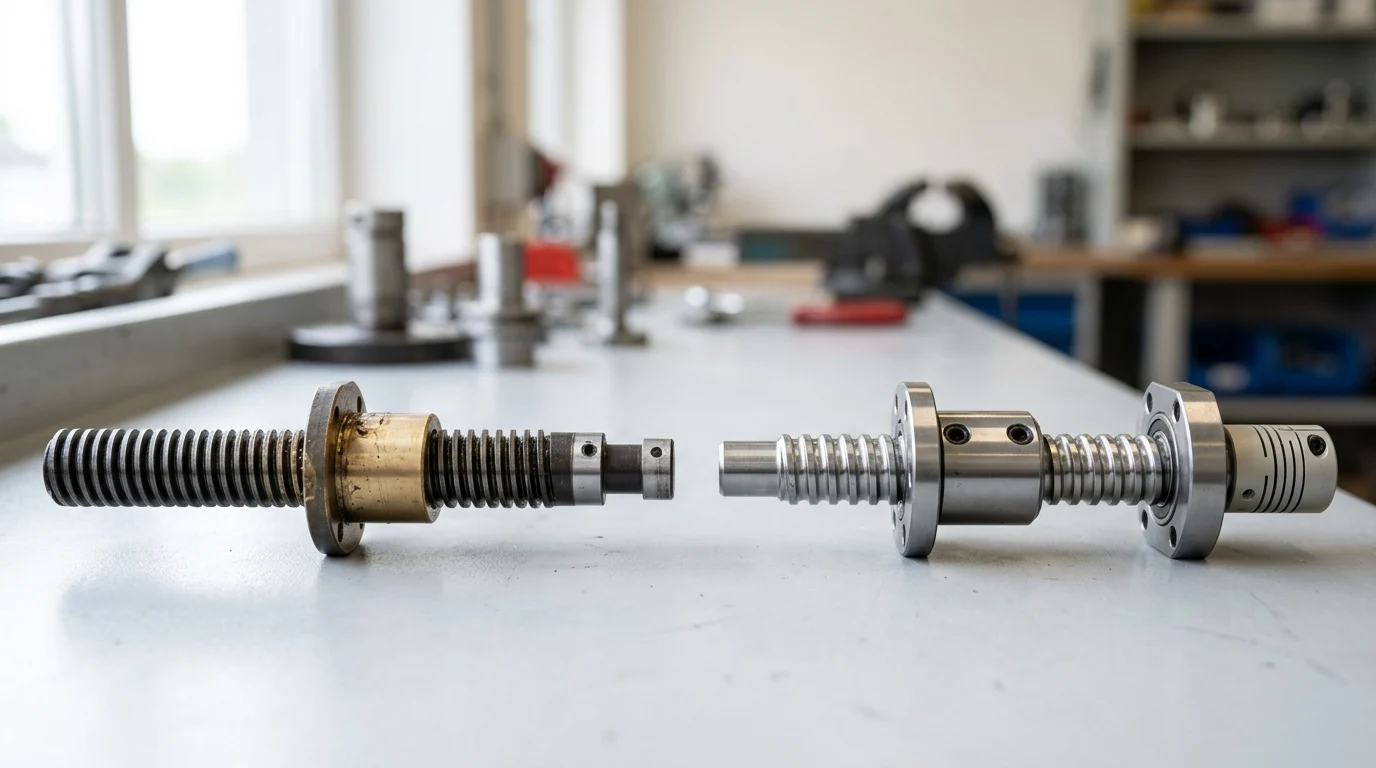
Choosing the right screw-driven linear actuator is not just a component decision—it affects motor sizing, positioning accuracy, heat generation, maintenance intervals, and total machine cost. Lead screws and ball screws both convert rotary motion into linear force, but they do it through very different friction mechanisms: sliding contact versus recirculating rolling elements. That difference can mean 20%–70% efficiency in one system and 90%–95% in the other. This guide compares how each mechanism works, where each performs best, and how engineers can balance upfront cost, duty cycle, precision, lubrication, and lifecycle value when specifying transmission components for industrial equipment.
Why the Lead Screw vs Ball Screw Choice Matters
The specification of linear motion components often forces engineers to decide between lead screw and ball screw mechanisms. While both translate rotary motion into linear thrust, their fundamental mechanical interactions dictate vastly different performance envelopes, lifecycle costs, and maintenance requirements. Selecting the incorrect technology can lead to premature mechanical failure, unacceptable positional errors, or unnecessarily inflated bill of materials (BOM) costs for the overarching system.
Key Motion Control Differences
The defining motion control difference between the two systems is the nature of their friction. Lead screws rely on sliding friction between the nut and the screw threads. This inherently generates significant heat and limits mechanical efficiency to a typical range of 20% to 70%, depending on the thread geometry and nut material. Consequently, lead screws require larger drive motors with higher breakaway torque to achieve the same thrust output as their rolling-element counterparts.
Ball screws utilize recirculating steel spheres to create rolling friction. This design dramatically reduces energy loss, consistently achieving mechanical efficiencies between 90% and 95%. The high efficiency of ball screws allows for the specification of smaller, lower-torque servomotors or stepper motors, which can offset the higher initial cost of the mechanical hardware. Furthermore, rolling friction eliminates the stick-slip phenomenon (stiction) common in sliding systems, enabling highly precise micro-positioning down to the micrometer level.
Cost, Performance, and Maintenance Trade-Offs
From a financial perspective, lead screws present a highly attractive initial cost, often pricing out at 20% to 50% of the cost of a comparable ball screw assembly. However, the total cost of ownership (TCO) must account for strict performance limitations. Lead screws are typically restricted to duty cycles below 50% to prevent excessive heat buildup and accelerated wear of the polymer or bronze nut.
Ball screws demand a higher initial investment due to the precision grinding or rolling required for the screw shafts and the complex internal return circuits of the nut. Yet, their ability to sustain 100% continuous duty cycles without significant thermal degradation makes them the more economical choice for high-throughput industrial automation. Maintenance also diverges; many lead screws with self-lubricating polymer nuts offer zero-maintenance operation, whereas ball screws strictly require periodic relubrication with specific ISO VG 68-100 oil or NLGI 2 grease formulations to prevent catastrophic spalling.
How Lead Screws and Ball Screws Work
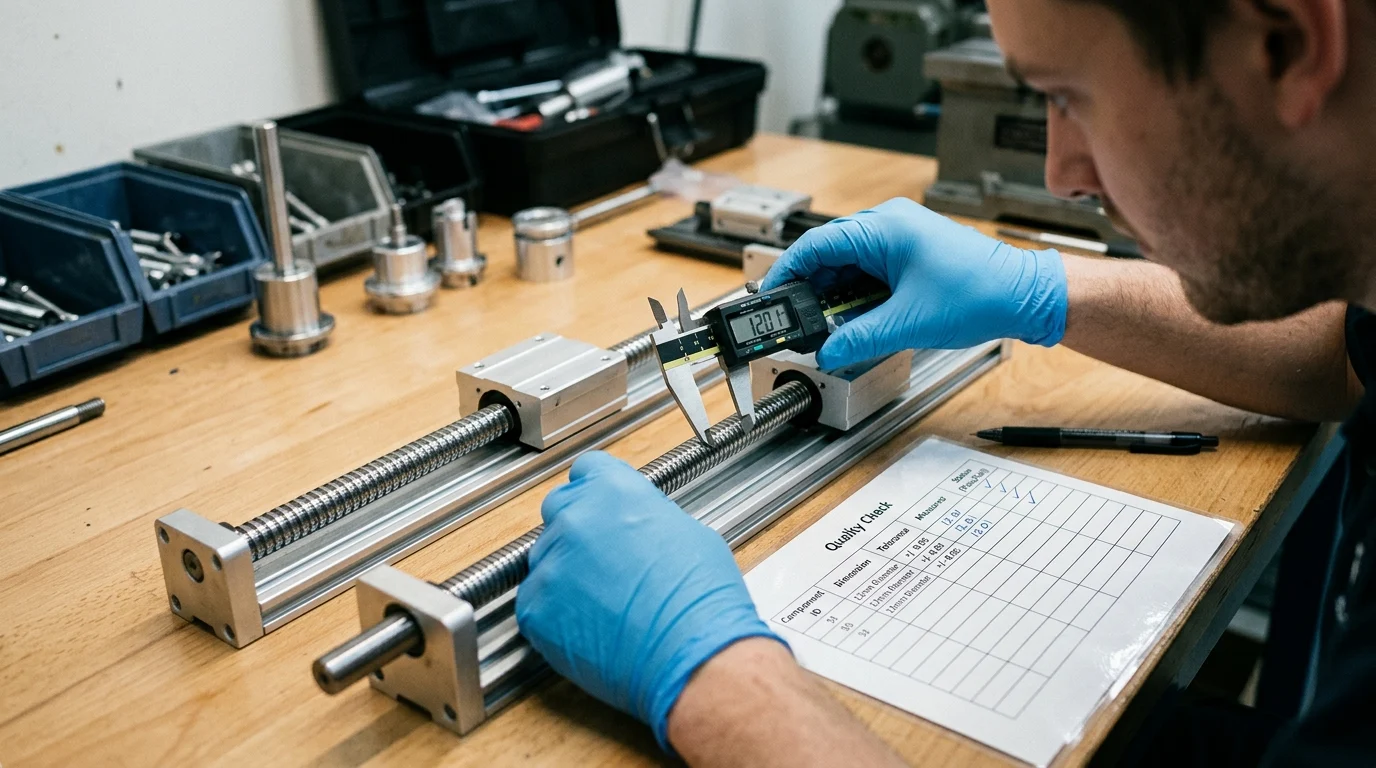
Understanding the internal mechanics of these two linear actuators is critical for matching their physical properties to the intended application. Both systems utilize a threaded shaft and a mated nut, but the method of axial load transfer differs entirely, dictating the physical architecture of the assembly.
Lead Screw Operating Principles
Lead screws operate on the principle of a simple machine: the inclined plane wrapped around a cylinder. When the shaft rotates, the mating threads of the nut slide against the screw threads, pushing the load forward. The most common thread profiles are Acme (featuring a 29-degree thread angle) in North America and trapezoidal (featuring a 30-degree thread angle) in metric markets. These robust profiles offer high shear strength and ease of manufacturing.
The nut material is the sacrificial element in a lead screw system. Engineers typically specify self-lubricating engineered polymers, such as acetal, PTFE-filled compounds, or PEEK, which offer a low coefficient of friction typically ranging between 0.08 and 0.15. Bronze nuts are alternatively selected for heavier axial loads, but they lack self-lubricating properties and require external grease application to prevent rapid galling of the metal-on-metal interface.
Ball Screw Operating Principles
Ball screws replace the sliding interface with a rolling bearing interface. The threads of both the screw shaft and the nut feature a concave, semi-circular, or Gothic arch profile. Precision steel bearing balls fill the space between these profiles, transmitting the axial load. As the screw turns, the balls roll through the helical raceway, exit the load zone, and are routed back to the beginning of the circuit via a return mechanism.
The recirculation mechanism is a critical design variable that impacts nut geometry. External return tubes are cost-effective and handle large ball diameters well, but they increase the nut's outer diameter. Internal button or deflector returns are more compact and allow for higher rotational speeds because the balls do not leave the nut body. The choice of recirculation directly impacts the maximum operational speed and the acoustic noise generated by the system.
Thread Design, Nuts, Lubrication, and Preload
Thread design dictates the load capacity and speed characteristics of the screw. Lead screws often utilize multi-start threads to achieve high linear speeds without exceeding critical rotational speeds. Ball screws, conversely, rely on precision-ground or rolled threads where the conformity between the ball and the raceway is tightly controlled. Rolled ball screws are common for general automation (accuracy classes C7 to C10), while precision-ground screws (classes C3 to C5) are reserved for tight-tolerance aerospace and CNC applications.
Preload is applied to eliminate axial play (backlash) and increase system rigidity. In ball screws, preload is typically achieved by using oversized balls creating up to a 5% diametral interference, or by using a double-nut configuration tensioned with Belleville washers, often set to 2% to 10% of the dynamic load rating. Lead screws eliminate backlash using anti-backlash nuts equipped with internal compression springs, though this constant radial pressure increases the sliding friction and further reduces overall efficiency.
Lead Screw vs Ball Screw Performance Comparison
A direct technical comparison reveals distinct operational boundaries for both technologies. System designers must evaluate these boundaries against the specific kinematic requirements, lifecycle targets, and accuracy demands of the machine being engineered.
Efficiency, Speed, Load, and Accuracy
Efficiency and load capacity define the primary dividing line between these linear actuators. Ball screws dominate in high-load, high-speed applications, while lead screws are optimized for lighter loads and slower movements where energy efficiency is a secondary concern. The DN value (diameter of the screw in millimeters multiplied by the rotational speed in RPM) serves as a critical speed constraint. Lead screws are generally limited to DN values under 40,000 due to severe heat generation at the sliding interface. High-precision ball screws, equipped with advanced internal recirculation systems, can safely exceed DN values of 150,000, enabling rapid traverse rates in modern machinery.
| Parameter | Lead Screw System | Ball Screw System |
|---|---|---|
| Mechanical Efficiency | 20% to 70% | 90% to 95% |
| Max DN Value (Speed Limit) | < 40,000 | Up to 150,000+ |
| Dynamic Load Capacity | Low to Moderate | Extremely High |
| Standard Lead Accuracy | 50 to 250 µm/300mm | 12 to 50 µm/300mm |
| Duty Cycle Limit | Typically < 50% | 100% (Continuous) |
Repeatability, Backdriving, and Noise
Repeatability refers to the system's ability to return to an exact target position over multiple cycles. Preloaded ball screws excel in this metric, frequently achieving bi-directional repeatability within ±0.005 mm. Lead screws equipped with anti-backlash nuts can achieve respectable initial repeatability (often ±0.01 mm to ±0.05 mm), but this precision degrades predictably as the internal spring-loaded polymer nut wears over time.
Backdriving and noise are also critical system considerations. Lead screws with a lead angle of less than 5 degrees are generally self-locking, meaning an axial load applied to the nut will not cause the screw to rotate backward. This is highly advantageous in vertical Z-axis applications to prevent load drops during power loss. Ball screws, due to their 90%+ efficiency, will almost always backdrive under load and require supplementary holding brakes. In terms of acoustics, lead screws operate quietly (often below 50 dB), whereas the clashing of recirculating bearings in a ball screw can generate 60 to 80 dB of noise.
Wear, Failure Modes, and Service Life
Wear mechanisms dictate the predictable service life of the actuator. Ball screw life is calculated using the L10 standard (often referencing ISO 3408-5), which predicts the number of millions of revolutions at which 90% of a sample group will survive before exhibiting metal fatigue or spalling on the raceways. This provides engineers with a highly predictable, mathematically sound lifespan under specific dynamic loads, allowing for scheduled preventative maintenance.
Lead screw wear is much harder to calculate definitively. The lifespan of a polymer nut is governed by the PV (Pressure-Velocity) limit, representing the product of the bearing pressure and the sliding surface velocity. Exceeding the PV limit causes rapid thermal degradation and melting of the plastic. Failure in a lead screw is typically characterized by a gradual increase in backlash and a loss of positional accuracy as the thread flanks wear down, rather than the sudden catastrophic spalling seen in overloaded ball screws.
Best Applications for Each Screw Type
Selecting the optimal linear motion technology requires aligning the mechanical characteristics of the screw with the environmental and operational realities of the application. The surrounding environment often dictates the choice as heavily as the required load and speed.
When to Choose a Lead Screw
Lead screws are the preferred choice when the application demands a low duty cycle, strict cost-effectiveness, and self-locking capabilities. In vertical lifting mechanisms, such as hospital beds, laboratory fluid pumps, and consumer 3D printers, the ability of a fine-pitch lead screw to hold a vertical load without power consumption or a secondary magnetic brake simplifies the overall machine design and reduces the electrical footprint.
Furthermore, lead screws are heavily favored in cleanroom environments, semiconductor manufacturing, and medical device assembly. Because specialized polymer nuts can operate completely dry without liquid lubricants, there is no risk of outgassing or particulate contamination from grease splattering. PTFE-coated lead screws paired with acetal nuts provide a clean, ISO Class 5 compliant, maintenance-free linear axis for highly sensitive production environments.
When to Choose a Ball Screw
Ball screws are mandatory for industrial applications requiring continuous operation, high axial thrust, and sub-micron precision. CNC milling machines, industrial robotics, and aerospace flight control actuators rely entirely on ball screw technology. The rolling element design guarantees that the actuator can withstand thousands of hours of 100% duty cycle operation without thermal failure, easily handling the massive thrust loads generated during heavy metal cutting or rapid positioning.
High-speed packaging lines and automated guided vehicle (AGV) lifting columns also utilize ball screws to achieve rapid cycle times. When the motor torque must be converted into maximum linear thrust with minimal energy loss, the 90%+ efficiency of the ball screw makes it the only viable engineering choice. The energy savings realized from using smaller drive motors often justify the higher initial procurement cost over the lifespan of the machine.
Environmental and Contamination Factors
Environmental contamination severely impacts both screw types, but in fundamentally different ways. A dry-running lead screw is relatively tolerant of ambient dust and non-abrasive particulates, as there is no wet grease to attract and trap debris. However, abrasive dust, such as ceramic or fiberglass particles, will rapidly lap away a polymer nut. Standard polymer nuts are also thermally limited, generally restricted to ambient temperatures below 80°C to 100°C before material softening occurs.
Ball screws are highly sensitive to particulate contamination. If debris enters the ball nut, it can jam the recirculation circuit, leading to immediate catastrophic failure, skidding, or severe scoring of the raceway. Consequently, ball screws operating in harsh environments require extensive protective measures, including dual lip wipers, telescopic covers, or protective bellows. Conversely, steel ball screws can withstand much higher operating temperatures than their polymer counterparts, often rated for 120°C or higher, provided high-temperature NLGI 2 synthetic grease is utilized.
How to Choose the Right Screw System
The final engineering specification requires a rigorous evaluation of the mechanical loads, kinematic profiles, and environmental constraints. Guesswork in the sizing phase inevitably leads to compromised machine performance, premature component failure, or an unnecessarily expensive BOM.
Define Load, Stroke, Speed, and Duty Cycle
The sizing process begins by calculating the equivalent dynamic load, factoring in the acceleration, deceleration, and constant velocity phases of the motion stroke. Engineers must also calculate the critical speed—the rotational velocity at which the screw shaft will begin to resonate and whip. Whipping is a function of the screw's root diameter, unsupported length, and the specific end-bearing mounts (e.g., fixed-free versus fixed-fixed configurations). Exceeding 80% of the calculated critical speed is generally prohibited to ensure operational safety.
Duty cycle must be quantified precisely. If the actuator moves for 10 seconds and rests for 10 seconds, the 50% duty cycle might barely fall within the acceptable range for a high-performance lead screw, provided the load is light. If the rest period is reduced, a ball screw becomes mandatory to prevent the nut from melting or galling due to unmitigated frictional heat accumulation.
Evaluate Suppliers, Materials, and Coatings
Material selection and surface treatments further refine the specification. Standard ball screws are manufactured from high-carbon alloy steels, such as 4140 or 52100, and are induction hardened to 58-62 HRC to withstand relentless rolling contact fatigue. If severe corrosion resistance is required, engineers must specify 300-series or 400-series stainless steel, though this softer material profile often reduces the dynamic load capacity by up to 50%.
Lead screws offer diverse coating options to enhance performance. Applying a proprietary PTFE (Teflon) or Armoloy thin-dense chrome coating to a 304 stainless steel lead screw drastically reduces the coefficient of friction and extends the PV limit of the mating polymer nut. Evaluating a supplier's ability to provide custom end-machining, certified runout tolerances, and specific anti-friction coatings is a critical step in the procurement process to ensure final assembly compatibility.
Final Selection Checklist
To finalize the selection between a lead screw and a ball screw, engineers should process their application parameters through a strict decision matrix. Prioritizing constraints such as backdriving limits, continuous duty requirements, and acceptable acoustic profiles will quickly eliminate the incorrect technology.
| Application Constraint | Lead Screw Recommendation | Ball Screw Recommendation |
|---|---|---|
| Duty Cycle | Intermittent (< 50%) | Continuous (Up to 100%) |
| Backdriving | Desired prevention (Self-locking) | Acceptable (Requires holding brake) |
| Lubrication | Dry running required (Cleanroom) | Oil or Grease strictly required |
| Acoustic Noise | Strict limits (< 50 dB) | Tolerant of recirculation noise (60-80 dB) |
| Budget / TCO | Low initial BOM cost required | High initial budget, low maintenance TCO |
Key Takeaways
- Select a lead screw for cost-sensitive applications with moderate loads, lower speeds, and duty cycles below roughly 50%.
- Use a ball screw when the application requires 90% to 95% efficiency, continuous operation, and precise repeatable positioning.
- Account for total cost of ownership, because a lower-cost lead screw may require a larger motor due to higher friction and breakaway torque.
- Plan lubrication into the maintenance schedule for ball screws, while considering self-lubricating lead screw nuts for low-maintenance designs.
- Match screw type to the operating environment, load, speed, accuracy target, and maintenance access before finalizing the actuator design.
Frequently Asked Questions
When should I choose a lead screw instead of a ball screw?
Choose a lead screw for lower-cost, moderate-speed applications with duty cycles below about 50%, especially when self-locking, quiet operation, or low maintenance is important.
When is a ball screw the better option?
A ball screw is better for high-speed, high-duty-cycle automation where efficiency, repeatable positioning, and lower motor torque are critical. Typical efficiency is about 90% to 95%.
Are lead screws less efficient than ball screws?
Yes. Lead screws use sliding friction and typically achieve about 20% to 70% efficiency, while ball screws use rolling friction and usually reach 90% to 95% efficiency.
Do ball screws require more maintenance?
Generally, yes. Ball screws need periodic lubrication with suitable oil or grease to prevent wear and spalling, while many lead screws with self-lubricating polymer nuts can operate with minimal maintenance.
Which screw type is more cost-effective?
Lead screws usually cost less upfront, often 20% to 50% of a comparable ball screw assembly. Ball screws may be more economical over time in continuous-duty, high-throughput systems.