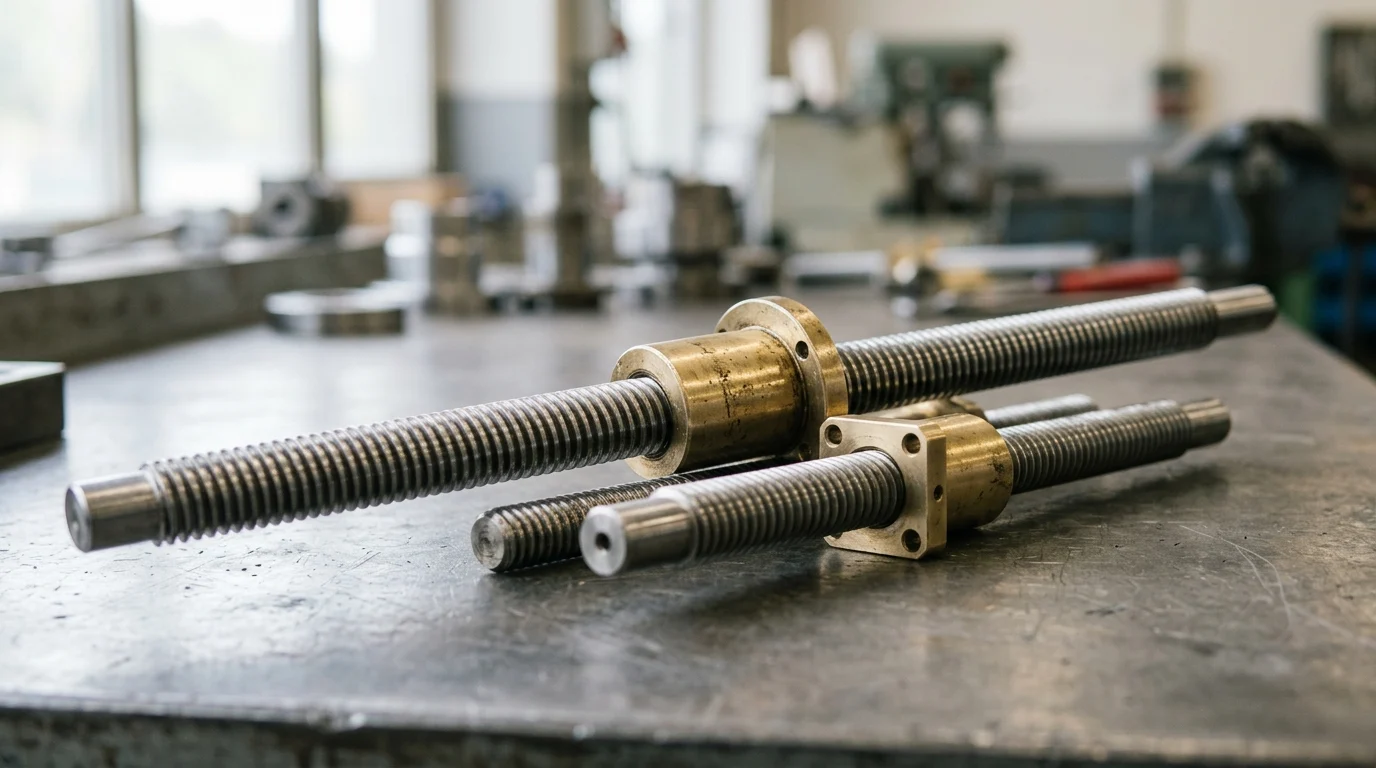
Industrial motion systems often fail or succeed at the screw-and-nut interface, where small choices in thread geometry, material, lubrication, and tolerance can determine accuracy, service life, and safety. Lead screws remain a practical solution for converting rotary motion into controlled linear travel, especially where low noise, compact construction, static holding force, and cost-effective customization matter. This article examines the standards, design requirements, and engineering trade-offs behind reliable lead screw selection, including efficiency ranges, self-locking behavior, PV limits, duty cycle, load capacity, and environmental factors. For manufacturers and equipment designers sourcing precision transmission components, understanding these requirements helps reduce wear, prevent overheating, and match each screw assembly to real operating conditions.
Why Industrial Lead Screws Matter in Precision Motion Design
Industrial lead screws are foundational components in precision motion design, translating rotary input from a motor into linear output through the sliding friction of a threaded shaft and nut assembly. Unlike complex multi-component linear drives, lead screws offer a streamlined, highly customizable architecture that excels in applications demanding continuous holding force and simplified mechanical footprints. Their inherent design relies on the precise interaction between the screw's thread flanks and the nut's internal geometry, making the selection of materials, thread forms, and lubrication strategies paramount to system performance.
While often overshadowed by rolling-element alternatives in high-speed applications, modern industrial lead screws engineered with advanced tribological polymers and precision-rolled stainless steel have drastically expanded their operational envelope. Engineers must rigorously evaluate the specific kinematic demands of their assemblies to determine where the sliding-contact mechanics of a lead screw provide the optimal balance of accuracy, cost, and long-term reliability.
Lead Screws vs. Ball Screws
The primary mechanical distinction between lead screws and ball screws lies in their friction mechanisms: sliding friction versus rolling friction. Ball screws utilize recirculating steel balls to achieve mechanical efficiencies exceeding 90%, making them ideal for high-speed, continuous-duty applications where minimizing motor torque is critical. In contrast, lead screws rely on direct surface contact between the nut and the screw threads, resulting in typical operating efficiencies ranging from 20% to 80%, heavily dependent on the thread lead angle and the coefficient of friction of the nut material.
| Characteristic | Industrial Lead Screws | Ball Screws |
|---|---|---|
| Friction Type | Sliding contact | Rolling contact |
| Typical Efficiency | 20% – 80% | 90% – 95% |
| Back-drivability | Low (Self-locking < 5° lead angle) | High (Requires braking mechanism) |
| Acoustic Noise | Very low (Polymer nuts dampen sound) | Moderate to high (Ball recirculation) |
| Particulate Generation | Low to moderate (Material wear) | Very low (Cleanroom compatible variants) |
This lower efficiency provides a distinct mechanical advantage in vertical or static load applications. Lead screws engineered with a lead angle of less than 5° are generally self-locking. This physical property eliminates the need for external mechanical brakes or continuous motor holding current to keep a payload suspended during power loss. Additionally, without the internal pathways required for ball recirculation, lead screws operate with significantly lower acoustic noise profiles and are less susceptible to catastrophic jamming in particulate-heavy environments.
Load, Speed, Duty Cycle, and Environment
The viability of an industrial lead screw is strictly dictated by the application's load, speed, and duty cycle, which are collectively evaluated using the Pressure-Velocity (PV) limit of the nut material. The PV factor represents the heat generation threshold of the sliding interface. Because lead screws generate internal friction, they are typically restricted to duty cycles below 50% to prevent the thermal degradation of polymer nuts. Exceeding the PV limit causes accelerated flank wear, loss of linear precision, and eventual catastrophic failure of the nut threads.
Environmental factors also impose hard constraints on material selection and operating parameters. Standard acetal (POM) nuts operate reliably up to temperatures of 80°C, while high-performance engineered plastics like PEEK or Polyimide can sustain continuous operation in environments reaching 150°C. In applications exposed to corrosive chemicals, washdown protocols, or hard vacuum conditions, engineers must specify unlubricated PTFE-compounded nuts paired with 316-grade stainless steel shafts. This ensures reliable motion without the outgassing, fluid degradation, or particulate agglomeration associated with wet lubricants.
Standards for Industrial Lead Screws and Thread Forms

Standardization is critical in the manufacturing and specification of industrial lead screws, ensuring dimensional interchangeability, predictable load ratings, and consistent global sourcing. While custom thread geometries are available for highly specialized OEM applications, the vast majority of industrial motion systems rely on internationally recognized thread forms.
Adhering to established standards allows design engineers to accurately calculate drive torque, predict lifecycle wear, and source compatible replacement components without relying on single-source suppliers. These standards dictate not only the macro-geometry of the thread but also the micro-tolerances required for precision linear positioning.
ISO, ASME, DIN, and JIS Thread Standards
The two most prevalent thread forms in industrial motion are the Acme thread, governed by the ASME B1.5 standard, and the Trapezoidal thread, defined by ISO 2904 and DIN 103. The fundamental difference lies in their geometry and measurement systems. Acme threads utilize an imperial measurement system and feature a 29° thread angle. They have been the standard in North American manufacturing for decades, prized for their robustness and ease of machining.
Conversely, Trapezoidal threads are the global metric standard, featuring a slightly wider 30° thread angle. While mechanically similar to Acme threads in terms of load capacity and efficiency, Trapezoidal profiles are exclusively metric, making them the default choice for modern, globally distributed equipment designs. The Japanese Industrial Standards (JIS) also align closely with ISO Trapezoidal specifications, ensuring seamless integration across European and Asian manufacturing ecosystems. Specifying the correct standard is the first step in guaranteeing compatibility between the screw shaft, the nut, and the supporting bearing blocks.
Tolerances, Fits, and Inspection Methods
The accuracy of a linear motion system is directly tied to the manufacturing tolerances of the lead screw, specifically its lead accuracy. Lead accuracy measures the deviation in linear travel over a specified rotational distance and is categorized into standardized tolerance classes. For example, under ISO 3408-3 (often applied to both lead and ball screws) or DIN 103, precision ground lead screws may achieve a lead deviation of 50 µm per 300 mm of travel. Standard rolled industrial screws typically fall into lower precision classes, offering deviations closer to 150 µm to 200 µm per 300 mm.
Fits and clearances between the screw and nut are equally regulated. Standards define the allowance on the major, minor, and pitch diameters to ensure smooth operation without excessive radial play. Inspection methods for these tolerances require highly calibrated equipment. Manufacturers utilize optical comparators and coordinate measuring machines (CMMs) to verify thread angle and flank straightness. For high-cycle applications, rigorous flank wear inspection is necessary; wear exceeding 0.1 mm on the thread flank often indicates the end of the nut's reliable service life, necessitating replacement to maintain positional accuracy.
Design Requirements for Industrial Lead Screw Performance
Designing an effective linear motion system requires translating high-level application requirements—such as payload weight, travel speed, and positional accuracy—into specific screw geometries and material combinations. The performance of an industrial lead screw is not determined by a single specification, but by the synergistic behavior of its mechanical properties.
Engineers must execute rigorous kinematic calculations to prevent premature mechanical failure modes such as column buckling or critical speed resonance. Simultaneously, the tribological pairing of the screw and nut must be optimized to minimize frictional losses and mitigate backlash over the assembly's operational lifespan.
Axial Load and Drive Torque Calculations
The foundation of lead screw design rests on calculating the axial load capacity and the required motor drive torque. Drive torque is determined by the formula: Torque = (Axial Load × Lead) / (2π × Efficiency). Because polymer-nut lead screws typically exhibit efficiencies between 30% and 50%, the motor must be sized to overcome significant frictional resistance, especially during high-acceleration profiles. Overlooking this low efficiency can result in stalled motors and missed steps in open-loop stepper systems.
Equally critical are the dynamic limits of the screw shaft itself: critical speed and buckling load. Critical speed is the rotational velocity at which the screw begins to vibrate harmonically, potentially causing severe shaft whipping. The buckling load is the maximum axial compressive force the screw can withstand before permanently bowing. Both calculations rely heavily on the end fixity factor of the bearing supports. An end fixity factor of 0.25 (fixed-free) drastically reduces the safe operating envelope, while a factor of 4.0 (fixed-fixed) maximizes both the critical speed threshold and the buckling load capacity, allowing for longer strokes and higher RPMs.
Materials, Nut Design, Lubrication, and Backlash
Material selection dictates the friction, wear rate, and environmental resilience of the system. Screw shafts are overwhelmingly manufactured from 300-series stainless steel for corrosion resistance or high-carbon steel for maximum tensile strength. The nut material is typically a self-lubricating polymer, such as PTFE-filled acetal, which provides an optimal balance of low friction and high wear resistance. Bronze nuts are utilized for exceptionally high axial loads, though they require continuous external lubrication to prevent galling.
Nut design is the primary mechanism for controlling backlash—the axial clearance between the screw and nut threads that causes lost motion upon reversing direction. Standard nuts exhibit initial clearances of 0.05 mm to 0.15 mm. For precision positioning, anti-backlash nuts utilize a split-nut design separated by a preloaded radial or axial spring. This constant tension mechanism actively compensates for thread wear, maintaining near-zero backlash (down to 0.01 mm) throughout the component's life, albeit at the cost of slightly increased drive torque and internal friction.
Lead Screw Type and Thread Comparison
The cross-sectional geometry of the thread heavily influences the mechanical characteristics of the drive. Engineers must select the thread form that best aligns with the specific load and efficiency requirements of the application.
| Thread Type | Thread Angle | Key Characteristics | Typical Applications |
|---|---|---|---|
| Acme (ASME) | 29° | High strength, easy to machine, moderate friction | Heavy machinery, manual actuators |
| Trapezoidal (ISO) | 30° | Metric standard, high load capacity | Global OEM equipment, packaging |
| Square Thread | 0° | Highest efficiency (no radial bursting force), difficult to machine | High-load jacks, custom lifting columns |
| V-Thread | 60° | High friction, self-locking, low efficiency | Fasteners, fine adjustment micrometers |
While square threads offer superior mechanical efficiency by eliminating the radial wedging forces that push the nut outward, they are notoriously difficult and expensive to manufacture. Consequently, the 29° Acme and 30° Trapezoidal profiles serve as the industry standard compromise, offering excellent axial load capacities while remaining economical to produce via high-volume thread rolling processes. V-threads, with their 60° angle, are generally avoided for power transmission due to their high friction, but remain useful in static, fine-adjustment positioning where extreme self-locking is required.
Specifying, Sourcing, and Validating Industrial Lead Screws
Transitioning from the design phase to procurement requires stringent specification and validation protocols to ensure the final product meets operational expectations. Sourcing industrial lead screws is not merely about ordering a catalog part; it involves navigating manufacturing tolerances, material certifications, and supply chain logistics.
For high-volume OEM production or mission-critical applications, establishing clear communication with the manufacturer through comprehensive drawings and robust quality assurance requirements is essential. This minimizes the risk of receiving out-of-spec components that could compromise the entire motion assembly.
Clear Drawing and Specification Requirements
A successful procurement process begins with a highly detailed engineering drawing that leaves no room for supplier interpretation. Beyond basic dimensions like major diameter and thread lead, the drawing must specify critical geometric dimensioning and tolerancing (GD&T) parameters. Straightness is a vital specification; a standard industrial requirement is a maximum deviation of 0.1 mm per meter of shaft length. Excessive bowing will induce cyclical radial loads on the nut, drastically reducing its operational lifespan.
Additionally, the drawing must clearly define the machining requirements for the screw journals—the unthreaded ends of the shaft that interface with the support bearings and motor couplings. Concentricity and runout tolerances for these journals should typically be held to within 0.02 mm relative to the thread pitch diameter. Failure to specify these tolerances often results in eccentric rotation, introducing vibration, noise, and premature bearing failure into the system.
Quality Testing and Traceability Records
To guarantee long-term reliability, engineers must demand rigorous quality testing and traceability from their suppliers. For critical applications, materials should be validated using EN 10204 3.1 material certificates, which trace the chemical composition and mechanical properties of the steel back to the original foundry batch. This ensures the shaft possesses the necessary tensile strength to resist buckling under load.
Surface finish testing is equally important for the tribological health of the system. The root and flanks of the screw thread must be exceptionally smooth to prevent the rapid abrasion of polymer nuts. A surface roughness specification of Ra < 0.4 µm is standard for maximizing polymer nut life. Manufacturers should provide profilometer test reports to verify this finish. Furthermore, dynamic lifecycle testing—running the specific screw and nut combination under simulated application loads to verify PV limits—should be requested during the prototyping phase to validate theoretical wear rates.
Cost, Availability, and Customization Factors
The manufacturing method heavily dictates the cost, availability, and lead time of industrial lead screws. Precision ground threads offer the highest accuracy but are significantly more expensive and have longer lead times due to the slow, abrasive machining process. Conversely, thread rolling is a high-speed, cold-forming process that hardens the surface of the steel and produces an excellent surface finish. Rolled lead screws are typically 30% to 50% more cost-effective than ground variants, making them the default choice for high-volume production.
Customization factors, such as non-standard leads or proprietary thread profiles, introduce significant supply chain variables. Custom rolled threads require the manufacturer to produce dedicated rolling dies, which often necessitates Minimum Order Quantities (MOQs) exceeding 500 units to offset the initial tooling costs. For low-volume customized requirements, engineers must balance the higher per-unit cost of machined threads against the extended lead times and tooling investments required for custom rolled solutions.
Choosing Industrial Lead Screws for Long-Term Reliability
Choosing the optimal industrial lead screw extends beyond theoretical calculations; it requires a holistic view of the application's lifecycle, maintenance capabilities, and total cost of ownership. A well-specified lead screw will deliver years of reliable service, but only if it is properly integrated into the broader mechanical system.
Finalizing the selection involves weighing performance trade-offs in a structured decision matrix and adhering to strict installation protocols. Even the highest-quality precision lead screw will fail prematurely if subjected to severe misalignment or improper lubrication practices in the field.
Application Decision Matrix
An application decision matrix helps engineers systematically prioritize design constraints. In medical device automation, for example, acoustic noise, particulate generation, and zero-maintenance requirements are paramount. Here, the matrix heavily favors PTFE-coated stainless steel screws paired with preloaded, anti-backlash polymer nuts, accepting the trade-off of lower maximum load capacity in exchange for clean, quiet, and precise operation.
Conversely, in heavy-duty packaging or agricultural machinery, environmental contamination, high axial loads, and cost-efficiency dominate the matrix. In these scenarios, large-diameter Acme threads with rugged bronze nuts are prioritized. The system is designed to tolerate higher backlash (e.g., 0.15 mm) and requires a scheduled greasing protocol, but it gains the ability to survive extreme shock loads and abrasive dust that would quickly destroy a precision polymer nut. Aligning the component specifications with the most critical operational realities ensures long-term system resilience.
Installation, Alignment, and Maintenance Checklist
The most common cause of premature lead screw failure is not excessive axial load, but radial and bending moments induced by installation misalignment. The linear guide rails that support the payload must be perfectly parallel to the axis of the lead screw. A standard installation tolerance requires parallelism to be maintained within 0.05 mm over the entire stroke length. Any deviation forces the rigid nut to absorb radial loads, causing localized stress concentrations, uneven flank wear, and severe binding.
Maintenance protocols must be established prior to deployment and tailored to the specific nut material. Self-lubricating polymer nuts often require no external lubrication; applying standard petroleum-based greases to these nuts can actually attract abrasive dust, creating a grinding paste that accelerates wear. For bronze nuts or high-load steel assemblies, a strict maintenance checklist must dictate the application of extreme-pressure (EP) lithium greases or specialized dry PTFE lubricants at calculated intervals, ensuring the sliding interface remains protected throughout the machine's operational lifecycle.
Key Takeaways
- Select lead screws by evaluating load, speed, duty cycle, and environment against the nut material’s PV limit before finalizing the design.
- Use lead angles below about 5° when self-locking behavior is required for vertical or static load-holding applications.
- Expect industrial lead screws to operate at roughly 20% to 80% efficiency, while ball screws typically reach about 90% to 95%.
- Keep lead screw duty cycles conservative, often below 50%, when frictional heat could degrade polymer or composite nut materials.
- Specify thread form, material, surface finish, lubrication, and tolerance class together because these factors directly affect wear, backlash, accuracy, and service life.
- Choose customized trapezoidal lead screws and nuts when standard catalog parts cannot meet load capacity, mounting, stroke, or environmental requirements.
Frequently Asked Questions
What standards are commonly used for industrial lead screw design?
Designers typically reference ISO metric trapezoidal thread standards, ASME/ACME thread practices, and application-specific tolerances for fit, accuracy, surface finish, and material certification.
When should a lead screw be chosen instead of a ball screw?
Choose a lead screw when the application needs compact design, low noise, lower cost, self-locking behavior, or static load holding rather than very high speed and efficiency.
What does self-locking mean in a lead screw?
Self-locking means the screw resists back-driving under load. Lead screws with lead angles below about 5° are often self-locking, making them useful for vertical lifting or holding applications.
Why is PV value important for lead screw nuts?
PV value combines pressure and sliding velocity to estimate heat generation at the screw-nut interface. Exceeding the nut material’s PV limit can cause wear, deformation, or failure.
What materials are used for industrial lead screws and nuts?
Common screw materials include carbon steel, stainless steel, and alloy steel. Nuts may use bronze, brass, engineering plastics, or self-lubricating polymers depending on load, speed, noise, and lubrication needs.